Showing posts with label review. Show all posts

30 August 2007

Review: Gossamer Webs and Richard Rutt

(you thought I'd never really get around to posting this after promising it for so long, didn't you?)

Photo Sharing and Video Hosting at Photobucket

Actually, first I just wanted to say to those of you who are reading on Bloglines or some other reader to totally go check out the comments on the last post. The discussion of the terms "flax" and "linen" continues, and there's lots of cool new information there. You guys rock! Also, goodies from Beth came in the mail today, and I spent the whole day dyeing with kool-aid. Details to come! Also possibly that video of the sheepdogs from the fiber festival, since blogger has conveniently just added a button for inserting videos. That'll have to wait till I have wireless access for the upload, though. Onward!

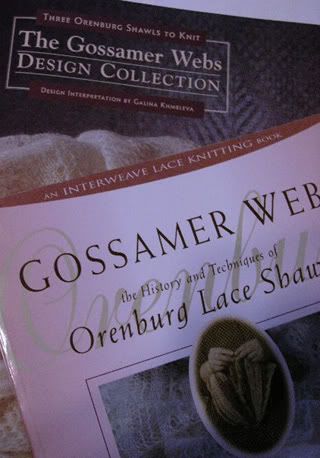
Okay, I'm finally ready to give you a full review of the wonderful Gossamer Webs: the History and Techniques of Orenburg Lace Shawls by Galina Khmeleva and Carol R. Noble (available from your usual sources or from Galina herself at Skaska Designs). I'll also explain what's in the companion book, The Gossamer Webs Design Collection and then go into a rant about Richard Rutt's A History of Handknitting (Interweave Press, 1987).

Wait - what? an unrelated book from 1987? Yeah, I know - trust me, they're connected, I'll get to it.

First, Galina's book. As you know if you've been reading this blog, I just took lessons with Galina Khmeleva on Orenburg lace spinning and knitting, but I got the first book, Gossamer Webs, before taking the lessons. I bought the Design Collection book after taking the lessons, and I'll explain why below.

Those of you who have been reading will also know that I've been getting more picky about knitting books of late, and that the ones I really feel are worth investing my money in these days are books that provide not just patterns and pretty pictures (both of which I use largely for inspiration, as I follow patterns straight from books fairly rarely), but books that provide solid, detailed, well-researched information that isn't available elsewhere (i.e., for free on the internet). That is to say that I'm no longer content with generalized run-downs of basic principles, and I'm completely out of patience with the sort of book that is 1/3 how-to-knit and 2/3 very unoriginal patterns in expensive yarns. I've given you some examples before of the kind of knitting book I want and love (Big Girl Knits, No Sheep for You, Victorian Lace Today, etc), and I'm happy to see that the knitting book market does seem to be shifting in this direction as the huge numbers of people who started or re-started knitting have acquired a vast range of new skills very quickly with the help of the internet. All good stuff, which makes me so excited sometimes that I tie myself up in knots of excitement and joy.

Gossamer Webs, though not at all a new book (1998!), is a perfect example - perhaps even the apotheosis - of what I now look for in a knitting book.

(Oh, I know, I'm totally a sucker for anything historical and anything Russian and anything about knitting, and this is a book about historical Russian knitting. But really, I'm about to explain why it's a really great book for other people, too.)

First, Galina really did her research. She is a native-born Russian whose career has always been in textiles, and who has been researching Orenburg lace knitting, specifically, since before the collapse of the Soviet Union in 1991 (and the subsequent closing of the Orenburg lace cooperative in 1995). She has spent a considerable time in Orenburg, getting to know the knitters and earning their trust. In the years since then she has painstakingly interpreted, recorded and disseminated the techniques that have been taught orally in Orenburg for centuries, so that they will never be entirely lost even if the original Orenburg lace tradition is unable to continue (though at the moment the knitters are still hanging on, with the help of those like Galina who bring attention to their work and, to the small degree that is possible, bring the authentic Orenburg shawls to Western buyers, as Galina does when she travels for teaching and fiber festivals).

Gossamer Webs is an extraordinarily comprehensive book, admirably covering the historical, social and economic aspects of the Orenburg lace tradition as well as the technical details of spinning and knitting the shawls while sharing throughout a palpable sense of who these knitters were and are.

In order, the chapters cover:


  • a brief overview of the history of the Orenburg region - this will easily and comfortably orient readers who don't have any previous background on Russia;

  • a history of the Orenburg shawls in particular, with a somewhat mythical account of where they began (because nobody knows) and a very well-documented and fascinating narrative of their popularity in the Victorian period (one shawl hangs in the Victoria & Albert museum) and the ups and downs of the industry after the 1917 revolution;

  • profiles of muligenerational current Orenburg knitters, whose stories themselves serve as a history of their region in the - shall we say "eventful" - 20th century, as well as of the evolving tradition of the shawls, including the circumstances in which they were and are created;

  • a translation of an excerpt from a Russian-language book on the shawls which offers a lively account of how shawls are sold by the knitters in the Orenburg market;

  • a brief account of Galina and Carol Noble's own "shawl-buying party" in Orenburg;

  • a chapter on the goats and their special down (it's not cashmere because Orenburg didn't join the cashmere association -- it's goat down of a quality equal to or better than "cashmere," depending of course on the goat and how it's been processed);

  • a chapter on spinning, on unique Russian spindles (this might be enough information for a very experienced spindle spinner to replicate it, but the rest of us really need to take the lessons);

  • a chapter on shawl design explaining the traditional motifs and structures and how they are manipulated by individual knitters;

  • instructions for a swatch shawl that teaches basic construction (again, there's enough info here for an experienced lace knitter to make a beautiful Orenburg-style shawl, but if your ambition is to make it just the way they make them there, including the same grafting and corner techniques, etc, you should take Galina's classes);

  • a stitch and border dictionary (Orenburg shawls are designed as permutations of a small set of basic motifs, so this is a dictionary of those motifs, which you could re-arrange in infinitely varied patterns in your own shawls);

  • instructions and charts for one large medallion shawl (it's very big);

  • and finally some reference material, including sources for recommended alternative fibers available to Western spinners and knitters, a bibliography, and two pages of photos showing an imaginative variety of ways to wear the shawls.


In short, it's meaty, comprehensive, unique, and inspiring. Here are a few things that get me particularly excited about it:


  • I love hearing about the knitters, in detail and often in their own words. These are not superficial, "oh, I've been knitting for 50 years and I love it" kinds of profiles, but rather really gripping stories about women of different ages, ethnicities, different levels of education, different careers and different life experiences who all share a lifetime of Orenburg lace knitting, and the profiles taken together offer a substantive, if open-ended, discussion of what that shared tradition means, to the knitters and to their community.

  • The knitting is presented in context: not only is there history here, but we also learn about the goats, and how they are tended, and how their fleeces are processed (by the whole family), and how the women first spin the yarn they need, and then how the finished shawls are blocked, worn, used, and marketed, both within the Soviet-era cooperative and through what was once a black market and is now an open and unregulated market (with the advantages and disadvantages of the change fully covered in all their ambiguity).

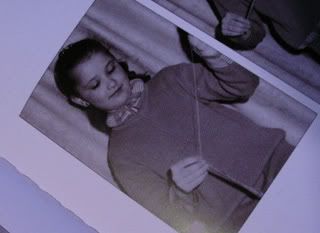
  • I love these pictures:

    Photo Sharing and Video Hosting at Photobucket

    If a girl of this age can do all this so confidently, surely I can too?

  • As a book about a particular regional tradition, it's important to me that the region in question is not simplified, sentimentalized, idealized, or demonized - as western "popular" works on non-western regions sometimes are. This book takes its subject seriously, covers it in depth and without prejudice (more on this below). Since I've been studying Russian language, literature and history (going on 15 years now) and living in Russia (a total of about 2.5 years now, and I'm off for another year in a few weeks) my family and friends are often puzzled by my very mixed feelings about Russia. Western accounts of Things Russian are often either very rosy (i.e., rhapsodizing about the culture and art while closing all eyes to the more complex economic and social context) or very, very demonizing (i.e., it's an Evil Empire, or more recently a third-world backwater, and everything there must be shoddy, or shady, or both, etc). The thing is, it's a complicated place, and it's history is complicated and it's hard to talk about any of it fairly in a western context because what little information Americans have about Russia is limited, at best, and totally wrong at worst. Of course, this can be said about any place, and there are certainly countries with even more frought histories (and presents). But because of the Cold War and the capitalism-communism clash of ideologies, Americans and Russians in particular sometimes have more than the usual difficulty in seeing each other clearly.

    I very rarely see an English-language, popular, non-scholarly work of any kind or any length about Russia that does not make me want to puke, strangle the author, or at the very least shake my fist pointlessly and spew bad language.

    Galina's book, however, does a simply stunning job of letting the ambiguities be ambiguities without sacrificing clarity for an audience that has not been to Russia and that has gotten its information hitherto from pretty poor sources. Of course, you might expect this from a book written by a Russian who has lived a long time in the U.S., but it's more rare than you might expect - the emigre experience carries its own baggage, and it's just plain not easy to maintain any kind of balanced perspective while being clear at the same time.

    So, in other words, this book doesn't pander to a Western audience by making us feel all warm and fuzzy and cleverer than some backward peoples who let their traditions almost die for lack of political sense ('cause god knows Americans are full of sound political sense...r i g h t...? er, sorry). It also doesn't pander to Russian sensibilities or nationalism by inflating the Orenburg tradition to make it the greatest, most innovative and complex lace tradition ever (again, see below), or by pretending that the Soviet-era lace cooperative (and modernity in general!) didn't play a significant role in bringing on changes that were ultimately destructive to the lace tradition and to the knitters. In reality, the book shows through its historical narrative and the profiles of the knitters how the 20th century, with its official state-run cooperative, brought with it social and economic security for knitters during difficult times and a means of reinvigorating lace design (i.e., one knitter who worked for the cooperative invented a system of charting to help teach other knitters and to streamline the knitting of more shawls) even while, at the same time, the same cooperative brought on other steamlining methods that reduced the quality of the fiber and robbed the knitters of important means of control over their livelihoods. Even more stark, though, is the change brought on by the collapse of the Soviet government and the mis-managed transition to quasi-"capitalism" in the 1990s - in reality, it's a free market run by robber barons in which the little people like Orenburg knitters are left with unprecedented freedom to knit as they like, sell where they like...but no security, no access to most markets, and increasingly expensive raw materials, leaving them prey to unscrupulous middlemen with an interest in quick profits for low-quality goods.

    This tells us a great deal about much more than Orenburg lace knitting, and in my humble opinion as an academic historian of the region and an occasional American traveler in Russia, it's a masterful book.


Okay, now for a quick break I'll tell you about the companion book before going into rant mode:

Theoretically, Gossamer Webs contains everything an experienced knitter and spinner would need to know to create an authentic shawl on their own. Between the swatch, the stitch dictionary and the one sample pattern, I thought at first that I could do this (although, strangely, I wasn't anxious to start right away). Then I got really lucky, and had the opportunity to take Galina's classes. The classes gave me the confidence to know that I could, indeed, make an Orenburg shawl of my own (though perhaps not from handspun just yet), and all the skills I needed to make it the way it's done in Orenburg down to the smallest detail. However, seeing as how I don't really enjoy frustration and confusion that much, I ultimately decided to also invest in the Design Collection book as well. This book re-prints the swatch instructions and the stitch and border dictionary that are in the main book, but also has detailed, text-and-chart instructions for three finished shawl designs: a triangle, a palatine rectangular 'scarf' (stole, really), and a medallion square of the same type, but different design, than the one in the Gossamer Webs book. Sure, I could probably come up with a pretty combination of the motifs from the stitch dictionary on my own, and I could probably work them into the triangle shape with some effort (I thought at first that I wanted a rectangle not a triangle, but then I learned how big these suckers are), and I could probably more or less maintain concentration while knitting both the border pattern and the interior pattern along with the new techniques for shaping corners and edges and everything...but then I could also probably be a brain surgeon if I really tried hard enough. But since I faint at the sight of blood and have no hand-eye coordination, it would really be better for everyone if I didn't, ya know? I feel that way about designing my own Orenburg, too. I think I'm going to make a couple from instructions first, then start playing with designing. So I bought the design collection, so I can follow the charts for a basic, traditional triangle pattern and have the written instructions to fall back on when I forget the details of what I learned in class about how to deal with corners and how to join the border on the long side. So...I wouldn't say that either the classes or the Design Collection are essential, if you're experienced and confident and intrepid. But your loved ones might really appreciate it if you did indulge in just a little extra information to fall back on.

Okay, now what does all this have to do with Richard Rutt's classic book, A History of Handknitting?

Rutt's book is to date the only one that attempts a comprehensive history of handknitting, and it is indeed an useful compendium of the technical historical details known at the time it was written. For that, I really do appreciate it very much. If nothing else, there's a great deal there to serve as a starting point for other writers who, I hope, will someday synthesize the huge amount of material on ethnic knitting traditions that has been compiled in the last couple of decades together with emerging social histories of textiles and other information to someday write a true comprehensive history of handknitting. However, Rutt's book, with the exception of only a few pages, is actually only a history of British knitting, and possibly just of Shetland knitting - its attempts to treat other traditions are appallingly inadequate and sometimes downright offensive (for some reason such sections almost always conclude in an unfavorable comparison to the Shetland tradition with which the author was clearly much more familiar than any other).

I know that publishers usually choose titles, and they usually push to make books as general as possible in order to garner a wider audience. So I don't entirely blame Rutt. But there's also a rather long history of what I call "British armchair historians." It's not that I have anything against amateur historians. There's no reason a person can't train themselves in the habits, methods, sources and literature required to write reliable, rigorous history. Having myself taken the traditional route of the PhD program, I can and have ranted at length about how many important skills formal training doesn't give you. So, when I toss off the term "British armchair historians" I'm not talking about amateur historians - I know of several good amateur historians who I rank among the best historians generally, British and not. Rather, I made up that term to describe a particular type of historian (with or without a degree), who is recognizable according to the following characteristics:


  1. They write history for popular consumption, but instead of interpreting this kind of writing (as I would) as requiring the same accuracy and rigor as academic writing but greater clarity, larger context, and better style, they instead interpret popular history as being free of the constraints of accuracy, fairness, respect for intellectual property, and sometimes rationality while being rather inconsistent as regards clarity and style.

  2. While sometimes telling a good story, they usually dispense with an explicit argument. This may sound like a point in their favor at first, because arguments are usually set out so clumsily in academic prose. But they don't need to be clumsy, and the truth is that a story without an argument is a story without a word as to what the story means. This may be okay. What is not okay is that in practice there's almost always something in there - even if it's between the lines - as to what the story means, and if it's not explicit, it's implicit. An implicit argument is insidious, because it affects the way the author presents the story without telling you how and to what degree. A particular perspective has been employed in selecting which parts to tell and how, but the reader has no idea what the assumptions were. The reader is being told to believe a tale that is purported to be "real" without having any sense of what the tale is based on or what was left out.

  3. They are unduly prone to think of England as the center of the universe and the rest of the world as a series of quaint little backwaters either ripe for the plucking, in need of civilizing (i.e., Anglicizing), or both. I assume this is a legacy of the Empire, but it's disgusting. (And yes, I know the English are not the only ones to take on this attitude by a long shot - I live in NYC after all! But even New Yorkers, when they write a history of NYC, call it "a history of NYC," not "a history of the world")


The implication of my term, then, is not that the historian in question is an amateur, but that the historian, metaphorically speaking, never leaves his or her comfortable armchair.

Sadly, Richard Rutt is a classic example of a British armchair historian, most especially as regards the third characteristic.

But here's my particular beef, which brings me to the connection with Gossamer Webs. Rutt's book contains a little over two columns of one page of text on knitting in Russia, which makes it one of the most extensive sources on the subject available in English. Some of this text is useful, but you should be aware that the author's unwarranted assumption that knitting probably did not "flourish" in Russia before Catherine the Great's "Volga German" immigrants brought it with them in the eighteenth century is simply false, and actually rather offensive, too (obviously, he doesn't think people as barbarian (read: Eastern [cf. Edward Said on Orientalism {ooh, flashback to freshman lit, sorry}]) as Russians could possibly come up with knitting without some help from a few nice Germans. Oh, lord preserve me from the British. (Except when I'm in an anglophilic mood - I do love my Jane Austen!)

Later research into knitting traditions around the world has firmly established that handknitting has a long, complex, and fascinating parallel history nearly everywhere on the planet, and Russia was not excluded.

Rutt mentions the tradition of shawl-knitting from the Orenburg province of Russia, adding little other than that such shawls feature "uncomplicated patterns." For those who have not yet been privileged to see a traditional Orenburg shawl in person, I recommend that you take a look at Galina's book next time you see it in a store or the library, and then think about what Rutt said (and mind you, he must have been able to see an original shawl in the Victoria and Albert museum). Here's my theory as to what made him say this (never mind that the statement is utterly gratuitous and could simply have been left out if he just didn't know anything). Having read Rutt and Victorian Lace Today and various other works on lace from an Anglo-American perspective, I know that historians trace a development in English - usually Shetland - lace knitting from patterns with only unidirectional decreases to those with matched decreases. Now, one of the very first things historical training is meant to teach you is to watch out for the word "development." Before the professionalization of history and many other changes in 20th-century scholarship, people (mostly privileged, white, Anglo-American people, but also a lot of others) tended to see "development" as a movement upwards and onwards, from something less 'good' to something more 'good,' rather than as simply movement...along...but not particularly directional. So, an armchair historian of this school who knows the history of Shetland lace and knows how to identify the age of a shawl design by whether it has unidirectional decreases (older) or matched descreases (newer), might look at a shawl from another part of the world and, seeing only unidirectional decreases, that armchair historian might conclude that the shawl in question is of a type less developed, and therefore less 'complicated', than shawls that feature matched decreases.

Does this sound like shoddy logic to you? Like laziness? Like not ever leaving your mental armchair?

How about this instead:

Anglo-American lace is marvelously complicated because the matched decreases, not to mention other techniques, like 3-into1 and 3-into-2 decreases, stockinette versus garter backgrounds and other variations culled from many foreign influences, make it possible to do just about anything a designer could wish. It's particularly lovely for mirror-image small motifs and is very easily (not to say necessarily) adapted to charting.

Orenburg lace is superficially simple in that it's always done on a garter ground, the borders are always edged with 5-hole teeth, and the decreases are unidirectional. Designs are almost always permutations of only about 10 basic elements, themselves made up exclusively of YO and k2tog. However, just as knitting itself is the act of infinitely varying only two basic stitches (or one stitch and its reverse) the mathematical simplicity of Orenburg lace principles forms the groundwork for infinite variation. Because there are only YOs and k2togs you can count by holes rather than stitches and rows. Because there are only 10 easily memorizable basic elements, you can (with experience) design on the fly, almost painting in lace as you move up a shawl, improvising combinations and recombinations of elements, because you are thinking, knitting and counting in elements rather than in stitches and rows. Because the elements are so simple, just like the knit and purl stitches themselves, you can combine them into any kind of pattern: representational, geometric, organic, etc. Because all borders are reducible to the mathematically perfect 5 holes (with the 5th hole of one tooth as the first hole of the next), the knitter can vary the width and complexity of the border design adjoining the teeth to an infinite degree, on the fly, without affecting the structure of the shawl or the method of turning corners.

Oh, and because Orenburg is so bloody cold, Orenburg goat down is among the warmest and softest fiber in the world.

And because Russia has long been a much poorer country than, say, England, traditional Orenburg techniques and tools are marvels of efficiency.

Sure, Shetland lace knitting is amazing. I can't wait to do more of it.

But it ain't all there is in the world, folks.

The following is a short bibliography of good books on knitting history. It's not at all complete - these are just the ones I've actually read. Most of them I own and love well.

  1. International Knitting History

    The best and most up-to-date supplement to Richard Rutt's work are the many books published in that last two decades on various ethnic knitting traditions. Each offers a different perspective on the history of handknitting that, though particular to a given region in each case, when taken together constitute a substantive narrative of how handknitting and its particular techniques have evolved around the globe (I know there are many others not mentioned here like Arctic Lace and the works of Nancy Bush, but I haven't added them because I haven't had a chance to look at them yet. There's also the wonderful Victorian Lace Today, which, though covering roughly the same ground with less detail than the Rutt book as far as historical information goes, is a much better book on every level, not even including the incredibly gorgeous patterns!).


    • Priscilla Gibson-Roberts, Knitting in the Old Way: Designs and Techniques from Ethnic Sweaters, Nomad Press, 2005.

    • Priscilla Gibson-Roberts, Ethnic Socks & Stockings: A Compendium of Eastern Design & Technique, XRX Books, 1995.

    • Priscilla Gibson-Roberts, Salish Indian Sweaters: A Pacific Northwest Tradition, Dos Tejedoras, 1991.

    • Lizbeth Upitis, Latvian Mittens: Traditional Designs & Techniques, Schoolhouse Press, 1997.

    • Galina Khmeleva and Carol R. Noble, Gossamer Webs: The History and Techniques of Orenburg Lace Shawls, Interweave Press, 1998.

    • Annemor Sundbø, Everyday Knitting: Treasures from a Ragpile, Torridals Tweed, 2001.

    • Ingrid Gottfridsson, The Mitten Book (also published as The Swedish Mitten Book: Traditional Patterns from Gotland), Lark Books, 1992.

    • Henriette Van Der Klift-Tellegen, Knitting from the Netherlands, Traditional Dutch Fishermen's Sweaters, Lark Books, 1985.

    • Beth Brown-Reinsel, Knitting Ganseys, Interweave Press, 1993.


  2. Knitting in America


    • Anne L Macdonald, No Idle Hands: The Social History of American Knitting, Ballantine Books,1988.


      This is an engaging history written by a professional historian with scholarly rigor and intentions (yet without sacrificing readability). It places handknitting within the tapestry of American social history in the nineteenth century, focusing on how and why Americans have chosen to knit or have used their knitting for charitable and other purposes, rather than on techniques or technical history. It provides wonderful historical context for the upsurge in knitting we are seeing today.


    • Laurel Thatcher Ulrich, The Age of Homespun: Objects and Stories in the Creation of an American Myth, Vintage, 2001.


    • Laurel Thatcher Ulrich, A Midwife's Tale: The Life of Martha Ballard, Based on Her Diary, 1785-1812, Alfred A. Knopf, 1990.


    • Catherine Clinton, The Plantation Mistress: Woman's World in the Old South, Pantheon Books, 1982.


    • Jane Carson, Plantation Housekeeping in Colonial Virginia, Colonial Williamsburg, 1975.


    • Jane C. Nylander, Our Own Snug Fireside: Images of the New England Home, 1760-1860, Alfred A. Knopf, 1993.


      These books are all scholarly works that contain knitting content only in passing, usually in the context of arguments about women's work and the place of textiles and needlecrafts in early American economics and society. You may have to search a bit to find the knitting content, but all of these books are rich in references, if only oblique ones, to fiber crafts of many kinds and do an excellent job of analyzing how colonial and early American life were deeply interwoven (pun intended!) with all the fiber arts.

24 June 2007

Book Reviews

Between the Amazon sale and my CC gift certificates (yay, airplane tickets!), I've gotten some new knitting books lately. So I thought it'd be fun to tell you about them here. It's not really fair to call them 'reviews' as I don't plan to be all that terribly professional about it, and because I wouldn't have said anything at all about them if I didn't like them. Also noted: I got Victorian Lace Today not that long ago, too, but haven't said anything much because my feelings precisely coincide with grumperina's: awesome book, see her reasons why (plus, of course, the awesome historical content). I'm also going to save talking about Galina Khmeleva's Gossamer Webs for another post, as I love it so very much and have so much to say about it that it deserves a post of its own. So that leaves: Knit2Together, Charmed Knits, and No Sheep for You.

Knit2Together: Since I got this on Amazon for $5, there's pretty much no way on earth it wouldn't be worth it, unless it turned out to not be about knitting or something. But I think I would have been pretty happy with it even if I'd bought it at full price, although with the caveat that I'm getting pickier about my knitting books (as my shelves groan with the books already collected), and this one has enough in common with other books I already own to make it inessential. What makes it inessential to me? (1) the technical information and hints are all things I've already gotten from other sources (although they're presented really nicely and would be great for any knitter who hasn't already scoured practically everything out there), (2) the fun chatty stuff also feels familiar, like I've read it several times before in other forms, but for all that it's still cozy and nice - it's not a bad thing, it's just not something I would buy the book for, having already bought a lot of other books with a similar vibe, and (3) only one of the patterns is already itching to jump off the page and onto my needles (that would be the felted house slippers, 'cause I can always use another pattern for those, can't make it up myself as I have proven by trial and major error [cf: Frankenstein slippers, scroll down], and these ones are among the cutest out there). That said, I still love the book and am glad I bought it. While I'm enumerating, here are the reasons I love it:

1. Tracey Ullman. How can you not love Tracey Ullman? I feel like I grew up loving Tracey Ullman, my love has never wavered, and now I find out she loves knitting the same way I love knitting. What's not to love? (PS: Favorite Tracey Ullman movie? I Love You to Death)
2. Until I read this book, it never entered my head that "ullman" means "wool man" in Norwegian even though, it's true, my Norwegian is not SO rusty that I forgot either of those words.
3. The patterns are designed by Mel Clark, whose aesthetic I mostly really like, even though just at this moment I'm not sure what besides the house slippers would be practical for me to make and wear right now. I absolutely adore the Ponsonby Suit, and can probably see myself knitting it eventually, though right now my patience and time are not at that level. The Tropical Garden Vest is seriously cute, though I'm not sure what the effect of it would be on my decidedly curvier shape. Would be awesome to knit for a girl of about 13 or 14, but right now I don't know any such. I simply worship the Pimlico Shrug and, oh lordy lordy, the Lacy Hug-Me-Tight, and I might at least knit the latter no matter what, but I can't honestly see myself wearing either except at home for dress-up. I can see other people wearing them and looking fab - just not me. I don't have the je ne sais quoi (sp??) to pull it off. The ginormous Doctor's Bag is gorgeous and would be lovely to own, but if the boring knitting didn't kill me, the finishing definitely would. The Witches Britches are adorable and would be an easy, relatively quick knit, but again, I really wouldn't wear them outside the house, and I already own lots of comfy house-pants that didn't require weeks of my time to make. I also love the Gym Slip Dress, but also think it would require some fairly major mods to work on me, and at the moment the inspiration isn't there for that (though it may come). Finally, the Rowena Cardigan is lovely - and it's just a plain, simple cardigan with one brilliant twist, which I could pretty easily reproduce at some point, though probably not right away.
4. Along with the gorgeous-but-not-immediately-practical(-for-me), there are also a few quickies in here that, while less exciting, are more likely to actually get made. A lacy, ruffly tea cozy, picture frames (which, yes, I might have thought of myself, but not gotten around to thinking through), the super-cute mouse family with clothes, Daphne's Baby Cape (a very EZ-type affair), a pretty table skirt for which I need only a table, and - folks! - a floppy "Lady Detective Hat" which will definitely get made! The Novella Socks and Pea Pod Cardigan are also both cute, and fall into the category of things that I'd love to have, but probably won't get around to knitting because other projects will continually get in the way.

All around, that's a good amount of knitting inspiration for one book, and I'm satisfied.

Charmed Knits: As this is a book of Harry-Potter-related knitting patterns, obviously you have to be a Harry Potter fan to get into it. Since I'm a very rabid HP fan currently in the throes of waiting for the last book to come out (26 days!), and determined to keep any future children I may someday have clothed in exactly the type of adorable, classic, Brit-knit style sweaters that fill the movies and the books, this book was of course a must for me. Though I'm still dying for a pattern for the sweater Ginny wore at the Quidditch World Cup in the movie, all the other essential HP patterns are in here, plus a few extra things I hadn't seen or thought of: an "invisibility shawl" and a blanket based on the idea of Mrs. Weasley's clock. The wand cozies, I must say, cracked me up in kind of the wrong way, but whatever. I also think the wizard robes and hats are kind of pushing it - these are definitely things that should be sewn, not knit, but it doesn't matter because the sweaters, hats, scarves and mittens are perfect and that's the key thing. While I think I could have unvented the accessories myself, the book is really helpful in providing affordable yarn choices in all the right colors. On the one brief occasion when I flirted with the idea of making a Gryffindor scarf (before remembering how much I hate making long, repetitive scarves), I couldn't find the right color combination, and started to lose my ability to remember what the true movie colors look like in the face of all the not-quite-right colors in the LYS. This books gives you a solid handful of alternatives, and that's really nice. And I'm totally making an invisibility shawl! (Since my favorite thing to be at parties is invisible, this should be perfect!)

No Sheep for You: So, remember how I said just a little bit above that I'm getting pickier about my knitting books? This book, along with Amy's Big Girl Knits (which is next on my list to get) are exactly what I want in knitting books now. What I love, love, love about both of them is that they are packed with hard-core, well-researched, well-presented technical information that is not available in this form elsewhere. I'm neither allergic to animal fibers (thank god!) nor (quite) beyond the usual size-range of standard knitting patterns, but I think these two books are the two most useful knitting books for me in a long time. I've been reading the major magazines, almost all the mainstream current books and a few oldies, and been fairly well entrenched in the online knitting world for several years now, and the information Amy gives in No Sheep for You on non-animal fibers is a revelation to me. I've seen profiles of some of the new yarns and fibers elsewhere, and I've read many a general survey of all the various fibers, but nothing has come close to this much information, all of it immediately applicable to my knitting. To be honest I've avoided using any of these materials, except for cotton and that only for dishcloths and bathmats, because the few items I've tried in the past have not worked out so well. Now I know that that's because I had no clue what I was doing - it was not the poor fibers' fault (well, there was some guilty acrylic...), but user error. Most wools are pretty easy to just pick up and knit and end up in a garment that will be usable, but the fact is that you can't throw hemp or silk into a pattern intended for wool and expect everything to work out. I had probably gotten as far as this realization in previous experiments, and concluded that I just didn't know what to do with those fibers, and maybe that I couldn't do much with them beyond put them into scarves. Amy's book takes the next step and shows how truly dazzling all these kinds of yarns can be in just about any type of FO if you do it right, and then shows you how to do it right.

The patterns are lovely. I want to make Tomato, and Hubbster has already registered his desire for the hemp "Manly Maze" sweater (actually, he'd been asking for a hemp sweater for ages, but I hadn't known what to do about it...) The intensely cabled and delicate Morrigan makes me go all wobbly. The Tuscany shawl is a must, and I'm going to dedicate to it the first skein of sea silk I can get my grubby little paws on. In fact, every single pattern in here is very desirable to me, though the others I haven't mentioned yet may be too ambitious, too expensive, or too fussy for me at the moment (which is not to say I won't get there eventually...). And they're all very timeless, more so than most books I can think of, which suggests that even if it takes me 10 years to be ready and able to make Morrigan or Sweet Indulgence, it'll look just as good then as it would now.

There you have it, folks. Next time: a long disquisition on the wondrousness of Galina Khmeleva (who I'm going to MEET in August!!! while also having a slumber party at Beth's!!! And seeing her spinning store!!! Aiiieeeee......)

Also of note: There's an event in NYC on Monday that I'm dropping everything to get to: 19th Century Knitting and Needlework in the park!!! I don't know any more than what's on that link, but my friend Aline and I are going, I'm bringing the set of US 000 DPNs I'm afraid of and some laceweight to see if I can experiment with what stocking knitting felt like 150 years ago. If you're in NYC and can go, drop me a line so we can find each other there!

05 May 2007

CotLin Review and 2 FOs!

Edited to Add: Actually, as it turns out, I'm less picky than the Harlot, too. Those unmatched ribs wouldn't bother me at all - in fact, I've probably done that inadvertently and not even noticed. Though I suppose it depends on how the sweater is supposed to hang (ribs stretched apart, or bunching up). Good to have these things sorted out. And good to know that cool technique from Veronik Avery - just in case...

Funny how you think you're "practically done" and will suddenly have more time...and your immune system kicks you in the ass and reminds you that, actually, you have to pay for all those months of poor diet and no exercise and stress....blaech. Anyway.

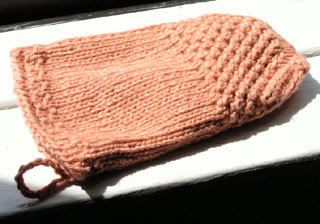
I finished a bath scrubby made out of my new KnitPicks CotLin!


This took only a very small part of the skein, so I'm going to make one more scrubby and maybe also something else.

Before I attempt any kind of review, a few caveats: I'm not a picky knitter. More Harlot than Grumperina, you know? And I've never had any trouble knitting with even something as rough as kitchen cotton (in three strands even!), though I also don't knit with cotton more than once in a blue moon. I'm also not exactly meticulous about...anything. So I'm maybe not the best reviewer in the world. But, I'm happy to share what I've noticed from playing with CotLin so far.


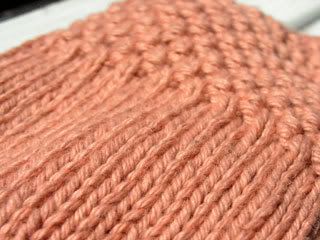
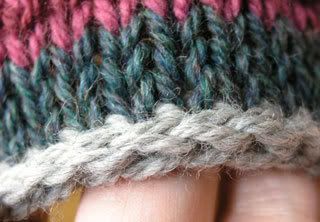
As you can see, the stitches are even and balanced. It has no noticeable elasticity, but wonderful drape. Check out the CO edge of the scrubby - I did 2 or 3 rows of stock st, then a row of k1, p1, another row of plain knit, then p1, k1 across, and continued in stock st. Not the slightest little hint of a roll - I think I could have left it in plain stockinette and it would have been flat enough for my purposes. The hand is similar to other non-mercerized cottons - it's soft in that cotton-y way. But it's also very light, and smoother than kitchen cotton. I personally very much enjoyed knitting with it, but like I said, I'm kind of insensitive to the hand-cramping others seem to get from knitting with inelastic yarns.


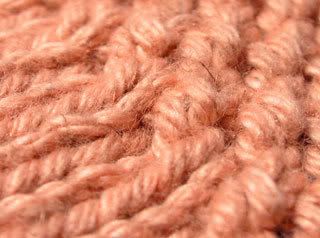
There are quite a few bits of very small, light plant matter throughout the skein. I started taking them out and then decided it was probably a good thing for a scrubby and left it in - you can see it in this picture. You can also see the slight, fuzzy halo from the cotton. It's less fuzzy than kitchen cotton, but not as sleek as linen (nevermind the shine of mercerized cotton. It's definitely something I would make a garment out of, but only a summery, casual, drapey sort of garment.

I haven't yet tried washing it or using it as a scrubby, since I decided to send this one off to Mom, with her new socks (see below) for mother's day, but I'm making the second one for me and will let you know if it does anything funny in the wash.

As for color - these pictures are accurate on my monitor. I love the light sport-weight gauge, allowing you to knit lighter or finer pieces than kitchen cotton.

Verdict? I've already ordered more, now that they've got the natural linen color in stock. I'm going to make some dishcloths, and I have a feeling I'm going to need to make still more in a variety of colors. I think this yarn fills a wonderful niche - between kitchen cotton and mercerized cottons and the more expensive and stiffer 100% linens and hemps - and I'm delighted to have it available, even though it's fairly limited, in my mind, to tanks or light summer tops, and washclothe/towel-type things. But maybe I'm just not using my imagination enough?


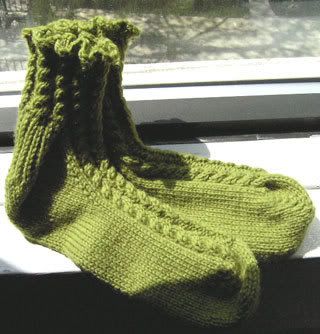
I also finished the Avocado socks for mom for mother's day. They look much less funny on the feet.


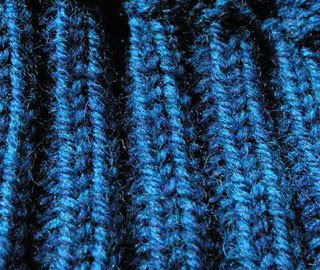
And, I've been knitting blue. Yummy.

20 January 2007

My Very Own Yarn (and a KIPer review)

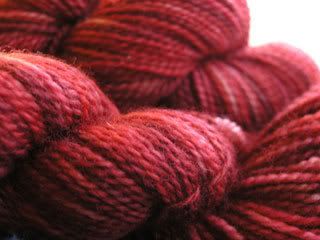
I got the yarn dyed for me by Krista!!!! Because I won her contest, she dyed the yarn specially for ME, and you all know what my color preferences are:


And of course she sent it in two separate hanks, which her contest-survey concluded is in fact the preferred way to have sock yarn, even though most sock yarns come in one skein. Why is that? Anyway. I love, love LURVE this yarn, and want to roll in it all day long. Krista named it "Strikke" for my blog, and had it on her etsy shop, though it looks like it might have already sold out! I've noticed that Krista's shop is updated constantly and there are always new colors - yum!

THANK YOU, KRISTA!! YOU ROCK!!

And now the long-promised review of my KnitPicks KIPer bag set! First - I think I figured out why there are so few photos of the bags on the KnitPicks site...black bags with black interiors are really hard to photograph. So, my apologies about the photos right from the start.

I've already said how much I'm in love with these bags. I've long been frustrated by the process of constantly moving all my stuff about from bag to bag and consequently never having the right stuff with me, and I've long day-dreamed about sewing myself something like this set, but never got around to it (because, frankly, I don't sew that well). Although I adore the many heartbreakingly darling knitting bags that have already been on the market since the brilliant Jordana Paige came out with her knitter's purse (in red!), my particular pauper's life in NYC has kept me from buying any one of them. Partly because I could only afford one such bag and how, how, how is one to decide among so many incredibly adorable bags?? More importantly, having invested in one of those adorable bags, my life would have become a constantly stressful mission to keep said bag from getting lost, ripped, scraped, or made filthy every time I stepped out into a subway tunnel or needed to set it down in a cafe. I don't need that kind of stress in my life. Instead, I very much look forward to a future where I'll have a car and live in a civilized place with trees and clean table-tops in cafes and I'll own at least one darling knitting bag that I'll carry with me everywhere. That'll be awesome, and I'm so looking forward to it. However, right now, I really needed something to carry my stuff in that was cheap, not ugly, sturdy, organized, and above all versatile. And in the city, the "stuff" that needs to be on my person at all times includes all the things that most normal people keep in their cars rather than their purse - things like water bottles and books and folders and whatever you bought or picked up while running errands. Yet, I also needed to have the smallest possible purse to grab for those rare occasions when we actually go to, say, a restaurant and a museum, and (since you can't check a purse, or lock it under the seat of your car) I needed to have something small enough to not look ridiculous and not weight me down (but still hold a book or a sock-in-progress for the train). I ask you, what was a girl to do? Ask Santa for KIPer bags, that's what.

I mentioned before that they turn out to look much less fake-pleathery than I imagined from the photos. In my opinion, at least, they're very respectable looking, if on the boring side, but that's what I was looking for. In every other way, as well, they are exactly what I needed them to be.

Here's how the set works (though each piece can also be bought separately): there's a small, simple notions bag, a purse with lots of pockets and credit card slots, then three bags of different sizes that can be attached to the purse. Everything except the notions bag comes with a solid, sturdy, adjustable pleather strap. So there are four possible bags to carry: just the purse, or purse+small bag, purse+medium bag, or purse+large bag. Each of the three attachable bags has at least a couple of interior pockets - one zippered, and one or more without closures. All of the bags have a one-way zipper to close them.

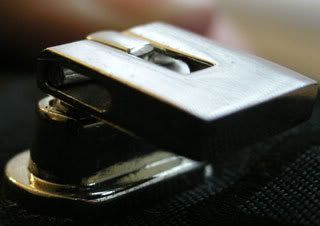
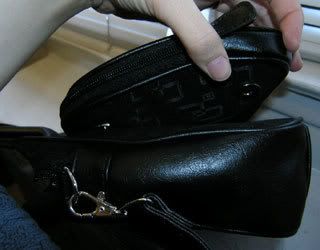
There was a small snag with my set at first - the smallest of the attachable bags had been damaged somehow (didn't look like in-transit, so probably at the factory), so that one of the clasps you use to attach the purse wouldn't open. We played with it for a good long while, but it wouldn't budge. The cylindrical piece that works as a hinge on the clasp had gotten bent:


This is what the undamaged clasps look like:


So, I was very disappointed and called up KnitPicks. Unlike every single non-yarn-related customer service line I've ever called in the past 5 years at least, they were very nice, very prompt, very clear. I explained the problem, and they sent a new small bag, and didn't even want the damaged one back (it's a perfectly good bag on its own, it just won't attach to the purse, so I suppose I'll use it to hold WIPs that say here at home; awfully nice of them to let me keep it, I thought). The replacement bag came in just two days, and was perfect, as were all the other pieces of the set. They seem very sturdy, and I can't imagine that the clasps could be damaged like that in any other way than being hit by a hammer or something along those lines.

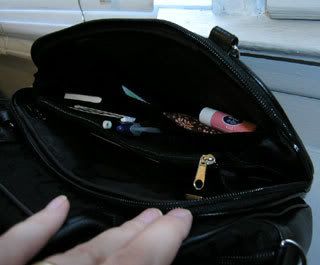
This is the purse part:


At first I tried to put my large-size "ladies'" wallet in here, along with cell phone, pens, tiny datebook, chapsticks, etc, and though it certainly all fit, it bulged, and that annoyed me. So I dropped the wallet idea altogether, since there are credit card slots built right in anyway. The cell phone, pens, and CCs/metrocard/ID all fit neatly into pockets that are made for them. In the center zippered compartment I have my passport and random receipts/slips of important paper, etc. On either side there's still plenty of room for the obligatory chapsticks, datebook, keys, headache meds, thumb drive, and a small change purse for what little cash I ever carry. The zipper reaches all the way around three sides of the purse, so it opens very widely, but the interior vinyl lining is solid across each side, so nothing's going to fall out. The strap, if you wear only the purse, attaches to rings on the top edge, placed one on each side of the zipper. I found this slightly awkward when I'd crammed the purse over-full, with too much weight on one side. Now that it's less full and more balanced, it hangs very nicely. It's not a cute purse - but it's definitely a respectable, practical, and usable purse.


The purse has two small metal openings and two magnets on one side. Each connecting bag has two clasps that fit very securely into the metal openings on the purse, locking down inside the purse part, and two magnets below them to hold the bottom half of the purse flush against the bag it's connected to. I think it's very clever, and feels very secure.


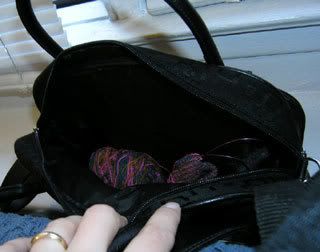
This is the smallest attached bag, with the Widdershin in progress inside. About the only thing you can tell from this picture is that the sock practically disappears inside. That's because it's more than big enough for a bigger project than a scarf. Maybe not a sweater, but certainly a sleeve, most shawls, scarves, and of course hats or socks would easily fit in here, along with the notions bag. For my purposes, since I rarely take anything but very small projects with me when I'm on the move, I'm using this bag for almost all trips and put in it a sock or similar project and a book, or two books if Hubbster is along. There's room to spare for an extra ball of yarn or pattern, though I usually dispense with such things. I really like that I can sit on the train with the top of the bag open, knitting over it, while the part that contains my purse and cell phone is securely zippered (and the bag(s) can be carried so that the purse part is facing out for easy access, or against my body for greater security). Also, while running errands, it's really nice to be able to reach in quickly for phone, credit card, metrocard, or any other item in the purse without getting tangled in yarn or having a book either spill out, or swallow up the sought-after item between its pages, all of which was freqently a problem with the other bags of various sizes I've used, when everything was thrown into one big cavity.


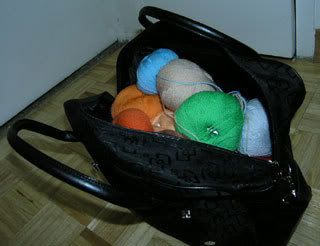
This is the biggest bag, and as you can see it can hold the entire KnitPicks palette sampler - 30 balls of yarn - with room to spare. It's plenty big enough for an afghan or whole sweater project, again with room to spare for a pattern book, notions bag, and more. Obviously, this combined with the purse is slightly more awkward for running around the city, although like the other two attached bags, you can carry it either by handles or a strap around your arm/shoulder. It would be perfect for S-n-B trips if you drive - you could fit several projects to show off, its slight awkwardness is no biggie, and this way you don't have to worry about forgetting your purse, because it's attached. For me, for now, I'm thinking of it as the ideal weekend / carry-on bag. I can put a couple changes of clothes, essential toiletries, and a travel knitting project in here, and be totally ready for a train trip anywhere on the east coast. Cool. Now I just need to get my butt on the train more often! I can also see myself using it - though I haven't yet - for trips to friends in Park Slope or shopping in Brighton Beach where I need to carry along the various things that I used to drag in an assortment of plastic or canvas bags along with a separate purse and separate knitting bag. I could have all this connected to one set of handles, now.

There's also a medium bag between these two, which I forgot to photograph (but it looks exactly like the other two, but in-between in size, duh). Much to my intense JOY, it's just big enough to fit a standard-size folder on its side. I can put a few folders, two huge library books or an assortment of smaller books, a sock project and a bottle of water in this bag. I can put the sock and its ball of yarn each in separate open pockets on one side of the interior, so they don't get lost in the bits of paper and random crap that will inevitably eventually settle into the bottom of the bag once I've used it more. There's still an interior zipper pocket for a xeroxed pattern, or, say, a stipend check or other important document. This is the bag I've been dying for for years. It's perfect for trips to campus for teaching or library missions, but also holds some knitting for the train and, separately and securely, all the essential purse items. It's comfortable and not too ridiculous-looking to carry with the strap over one shoulder and across my chest, which is how I prefer to carry any bag in the city, though it looks more appropriate hanging on one shoulder. I love that it also has the comfortable, sturdy, handles for quickly picking it up and putting in down in the process of running around all over campus. So far, I've been keeping my current pile of folders and books in this bag, and putting whatever small sock or scarf I feel like working on in it on my way out the door. I keep a sock in the other, smallest bag and so far it stays there - I think I'll always keep a sock going to be worked only from this bag - so I can grab it and go for every kind of trip that's not to campus. The big bag, for right now, is holding my Palette Sampler yarn and still-not-fully-steeked sweater, in waiting for my next trip out of town (or at least to another borough!)


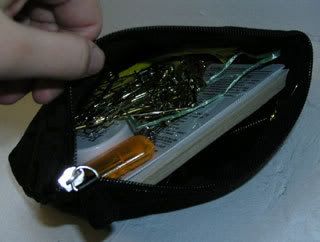
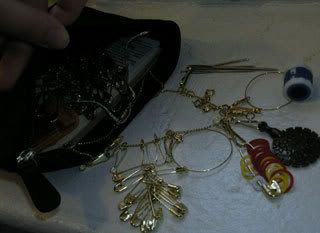
My only disappointment, really, is that the notions bag is just a small sack with no interior pockets. I would prefer a bunch of small pockets, slots, and loops in here so I could arrange my notions in a way that made them easier to get to, but I can understand why they didn't do it. Not only would it cost more, but every knitter would want a different arrangement. While I continue to fantasize about the customized notions insert that I'll sew myself someday, I've come up with something else, which is the result of another daydream I've had for a while:



In addition to the laminated cards that have crucial reference info on them, a thin graph-paper notebook, a needle gauge, waste yarn, extra markers and crochet hooks, I also have pinned into the side this chain. On my last trip to the going-out-of-business-really-slowly P&S Fabrics, the yarn was still only 10% (a couple of weeks into the sale!) but notions and random crafty stuff was at least 25% off. So I got this cheap little chain and few packages of various kinds of hooks and clasps. As you can see, I actually attached every hook and clasp I got to the chain, though I'm going to take off all but a few because they get so tangled. The idea was to have a chain like a charm bracelet that would hold the smallest essential things, the kinds of things that constantly roll under couch cushions (or subway seats): darning needles, coil-less pins, a row counter and a Clover cutter thingy so I don't scare security anywhere with my plastic children's scissors. I can just pull the chain out of the notions bag and leave it lying next to me on couch or table, or I can actually clasp the chain around my neck! (though so far I've only dared to do the latter at home - if you walk around dressed like Jesus and carrying a cross in NYC, you're not even looked at twice, but if you tie knitting notions around your neck in public you're a total lunatic). So far, I keep this notions bag mostly at home, because for the most part I'm careful to take out of the house only projects that require many ongoing rows of a simple pattern, with plenty of yarn/rows to last for the whole trip, specifically so that I won't require any notions. But since I've switched all my notions to this bag, I can easily grab it and drop it into any of the attachable KIPer bags whenever I want. I even fit in there some of the things I rarely use - like an extra-long darning needle, a mini-calculator, and for some reason that thingy for holding two yarns on one finger which I've never used at all. In addition, I have another notions stash of extras of everything plus the truly strange, unidentifiable notions and pom-pom makers are kept in my old, bigger notions bag in the craft closet. I really appreciated this new system when packing for our trip to Georgia - instead of sorting and deciding which notions could conceivably be needed for that specific trip, I just took this bag as it was.

I have really only one gripe, and it's not a gripe so much as my fantasy for the one improvement they could make in future versions of these bags: I would like to have two-way zippers. It's just a thing with me, but I really like to have them. For security in cities like Moscow and NYC, I like to be able to have the zipper end at the side where my hand is resting, so I know no one's opening it (lest you think I'm paranoid, I was pick-pocketed or almost pick-pocketed 5 times on a one-month trip in Moscow, and never had anything of substance stolen even though I was stupidly carrying lots of cash, my new palm pilot, and someone else's camera, all because I had stashed these items in hidden interior pockets or directly under my hand where it rested on the bag(s).) I also like to be able to zip up the sides of a bag but leave a small space open at the top, so I can leave the yarn inside while I'm knitting but still have the bag mostly closed. I can do this now, with the yarn coming out the side of the bag where the zipper is almost-closed, but because the yarn is coming out at an angle, it tends to get caught on the zipper. I wouldn't want to skip the zipper altogether - it seems like the most secure closure that doesn't add weight or take forever to get open, or require two hands - so a two-way zipper would be perfect in my humble opinion. Slightly more complicated, and probably less likely to happen on future bags, would be some kind of clever flap or loop near the top of the bags that you could feed yarn through, so you could have the bag itself actually closed while you knit. That would be neat. But not necessary. These bags are really, truly, great as they are.

All this new-found organization is really going to my head. I mentioned before that I also have this plan for a masterful knitting cheat sheet, on which I plan to gather every piece of knitting knowledge I could ever need in a form that can be folded small and taken with me everywhere. I already have a version that fits on one folded sheet and contains about 40 techniques (e.g., COs, BOs, incrs and decrs, when to use what, stretchy ribs, grafting, etc), about 30 patterns for the most versatile things or things I really will make over and over (e.g., EPS with all shoulder options, PGR sock and my new quasi-Widdershin with my own weird shaping, warshcloths, log cabin rules, fetching and Mrs. Beeton, etc), plus a small but growing list of small motifs that can be inserted into anything. I've included all those clever size-guessing hints in the Harlot's Knitting Rules book, also. How does it fit, you ask? The answer: tiny font. 0.3" margins. In 2 columns for readability. Printed book-style with 2 pages per side of each sheet, with a fold at the side, so it opens like a book and is read in that order. And I've abbreviated everything in my own idiosyncratic way that (sorry, guys) only I would ever understand. I use the shorthand I've always used for all knitting terms, and shorten words absolutely whenever possible (&, btwn, 'w' for with, etc). And I've taken out all parts of the patterns that I think - perhaps fatally - I don't need. Things like "join to work in the round, being careful not to twist" become "join" and "Bind off loosely. Weave ends" becomes "BO". Some of the patterns that I've done a lot are even more shortened, but patterns that confuse me no matter how often I do them - like when to do the first YO in the PGR toe - are written out almost fully. I've incorporated a lot of short cuts that I've only just recently learned from the EZ/Meg Swansen Knitting Glossary DVD (I've watched it all the way through 3 times now, and that's not counting the many, many times I've replayed a particular technique...like, 20). Most life-changingly, Meg has a super-simple way of explaining the otherwise insanely complex tubular BO (tho I'm still not certain it will work for double rib - will soon try and let ya'll know). Her explanations are also great - very intuitive - for a whole legion of cool cast-ons that I knew of from Montse Stanley but that had many times driven me to distraction. So I combined in my cheat sheet the awesome precis Montse gives for which CO/BO to use in which situation, but abbreviated the instructions according to the infinite wisdom of dear Meg Swansen. (Btw, Meg also finally de-mystified for me how to do tubular stocking stitch in the round. The explanations in books are always for flat knitting, usually without saying so, but I'd only ever tried it in the round, on cuffs, and could never figure out why it wasn't working. THANK YOU, MEG!!!!)

The only things that have defied my quest to be transferred onto a tiny sheet, so far, are charts for lace or color motifs (that may have to be a separate project), and the patterns for the various Bev Galeskas felted footwear items.* I would really like to have those, since I'm so likely to be knitting them over and over, and just at this moment I feel like I practically have them memorized so it'd be no big deal to type up a few reminders...but I know that I'm going to look at something like that a few weeks from now and be totally mystified. So maybe I should just separately laminate xeroxes of those patterns right out of the book, so they can be taken with me at the drop of a hat.

Eventually my plan is to laminate this cheat cheet, so I can mark it up with a dry-erase marker to help keep my place (since, after all, the text is miniscule), but right now it's still evolving constantly. I would really like to have it printed out in such a way that I could make it into a little book of index-card size, so it would fit into my notions bag and match the reference cards I have from Patternworks. But so far the best I've been able to get is book-size half-sheets, and that will still fit beautifully into the zippered interior pocket that's in all three attachable KIPer bags. The beauty, of course, it that I can laminate three or more cheat-sheets and stick one in every bag, or indeed, in every crevice in my apartment as well, so that it's always handy. Three cheers: I will never be at a loss to remember how to begin kitchener stitch again!!

*I seem to have convinced several of you to give the Galeskas book a try: so I might as well give you a mini-review here, especially since I saw one bad review of it on Amazon and I want to counter that. The bad review basically said that the patterns are boring. I would argue that, unlike most of the other felting books I've seen, the patterns are tasteful. But that's neither here nor there - it's not really the point of the book. The point as I see it is to break down the so-often unpredictable felting process in a reasonably scientific manner, so that the knitter can understand all of the things that happen, or can happen, and therefore get better at designing or adapting designs for herself and be reasonably certain of what to expect in the results. The patterns for purses, rugs, pillows and hats are indeed very plain, and obviously intended to serve merely as a template for how much yarn, needle size, and rough proportions you need - that is, the stuff that's really hard to just wing it with in felting - so that you can extemporize from there. Meanwhile, the patterns for the "ballet slippers", the moccasins, and the mittens - the only ones I've actually made from the book - are totally kick-ass by any measure and for any purpose. I've never seen a design so intensely clever and miraculous as her slipper patterns, and the resulting slippers are still the sturdiest and most respectable-looking of any felted footwear I've seen yet (though I still love fuzzy feet for quickness, ease, and the small amount of yarn required). I made the pair of mittens for my dad, too, and they're also wonderful, with some short-row shaping across the top of the upper hand to that they curl just so for greater mobility. That's the sort of thing that would have killed me to figure out on my own, which is what makes this book so valuable in my opinion.

06 December 2006

All Good Things

Lots of good things have been happening, just when it was most needed thanks to holiday / end of semester stresses and that constant growling that's still coming from my two pairs of unfinished socks. I haven't touched the socks, and actually stuffed them in the closet so the growling wouldn't be quite so loud. But now that I have the plain blue yarn to finish the peacock socks with, I plan to do them while on vacation in Georgia over the holidays, since, of course, socks are perfect travel knitting, and by that time they'll both seem totally new to me and the angst about all that ripping (in one case) and yarn shortage (in the other case) will have faded.

In the meantime, I've been happily knitting up super-quick projects on huge needles using cheap leftover yarn. Yeah baby - just the right stuff for the current mood. It's all stuff for felting while we're in Georgia, in the handy suburban washing machine.

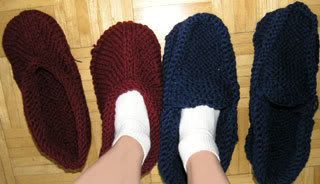
First, I finished the slippers for the in-laws:


Both in-laws have considerably smaller feet than I do (Hubbster's, though wider, are actually the same length - embarrassing). This is the sum total of my xmas knitting for this year. I've gone crazy in previous years - the scarf year, the felting year - and I think there may be a sock year in my future (most challenging yet!) but this particular year I decided I'd better just finish the bloody dissertation. I have the rest of my life to knit. (ooh, doesn't that sound lovely?)

And I actually went ahead and felted the blue pair of fuzzy feet, because I'd had to finish the toe in a different yarn (I don't seem to have good luck with blue footwear), and I wanted to hand-felt in this case to control the process. It turned out to be totally easy. This is the first time I've used Lamb's Pride, and I see now why it's such a good felting yarn - it starts felting really quickly. I love Paton's Classic Wool too for its reliablity, color selection, and price, but it does take a bit longer to get going. That's not a problem in a machine, but really makes a difference by hand. When I ran out of the Lamb's Pride I did the last toe in some 50-50 wool/mohair in red that was leftover from a sweater. It was made in Russia but called "Natural Mohair" in English with no apparent brand name - so I don't know what the heck it is. But it was exactly the same gauge as Lamb's Pride and similarly lightly spun, and in the end it felted exactly the same way. Since that sweater wasn't much of a success, I'm tempted to rip it up and make it all into fuzzy feet!


(The blue part in the corner above is from an unfocused picture that actually showed the accurate color). But so far I still have some leftovers to work with, so I'm experimenting with making another pair of fuzzy feet in different dimensions:


This one is a little bigger around (48 sts instead of 44) and much longer, because I want a slipper that's a little longer than the others, but much more tightly felted. Since stock. st. felts much more vertically than horizontally, I made it bigger in length than in width from the pattern. You never know if that sort of thing will work, though, and in retrospect I'm thinking it would have been a better idea to follow the pattern but on bigger needles with a double strand of yarn, to get more or less the same slipper but thicker. Anyone else out there experimented with this before??

Finally, I've been playing around with leftover felting yarns to make a handbag:


I wound random lengths of yarn into a ball, tying the ends (since they're just going to get felted anyway, I can snip the ends that stick out), and then just knitted mindlessly from the ball. This has been wonderful fun, especially since I forgot the order of the colors I'd picked as soon as I finished making the ball, so unwinding it as I knit felt like constantly discovering a new surprise. I think the level of fun I was having with this tells you something about my state of mind right now.


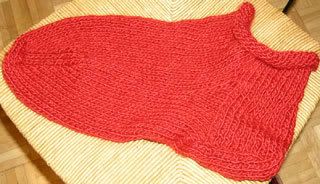
This is the body of the bag, hanging upside down over the back of a chair; I'm just working on the straps now. The bottom is a rectangle in black garter st. I picked up sts around, and just knitted a straight tube up. I didn't decrease at the top because I want the sides to sort of splay outward, as felting does with a large tube of stockinette. I'm loosely copying the shape of my Steve Madden handbag (which I found at Filene's for $20 and have been deeply attached to ever since, to the point where it's wearing out even though it's an incredibly sturdy construction). Except I want the straps to be just a smidge longer - it always drives me nuts that that handbag won't stay on my shoulder when I'm wearing my winter coat. I also wanted to make the braided straps that Laura showed us with a different, smaller handbag pattern. Of course, predicting exact length when you're not only felting, but felting a braid, is utterly impossible, but we'll see how it goes.

While I was working on my dissertation on this bag yesterday, the postman - the blessed postman! - came with a package! An early xmas present from my dad. So, you ask, did I wait, like a good girl, until the 25th to open it? Oh no. I saw the return address, and I opened. It was the DVD of Elizabeth Zimmermann and Meg Swansen's Knitting Glossary. I watched the whole thing all at once. I am in HEAVEN. I want to spend the xmas break (after finishing the socks) trying out every last technique in swatches. At first Hubbster was sort of giggling at me in an "oh, how sweet" way when I said I was going to watch "a knitting glossary" straight through for my evening's entertainment. Then, as he was reading his book nearby, he giggled in an "oh, isn't that adorable" way when I kept exclaiming things like

"Oh my God!"

and

"But that's...that's brilliant!"

...while watching two ladies knit quietly...

and then...he started watching. And then he started exclaiming! --

"Wow! That's really amazing! Can you do that?"

And I replied, naturally, "I can now!" :-)

I couldn't resist trying out quite a few things in the knitting I was doing at the same time - short rows without turning the work, two colors on the left hand in Meg's way, etc - which luckily I could do and undo in the handbag with no worries, since felting will cover any oddities in gauge. I decided to finish off the top edge of the bag in applied I-cord, now that I know how to do it:


This is just 2-stitch I-cord, which is neat because it's like the usual chain bind off, but instead of one chain of Vs along the top, you get one chain on each side of the top. I dunno, it's just pretty, and surprisingly fast. I never bothered to learn attached I-cord from any of their books before because it looked like it would be slow, and I never have patience for that kind of slow trimming/decorative thing. This was really no worse than most bind-offs, though, and there are so many possibilities for what you can do with it. And now that I'm working on the straps of the handbag - 6 skinny strips for the braids - I'm practicing knitting back backwards. I'm still a bit awkward at it, but I'm quickly becoming addicted, and the gauge I'm getting is no worse than my purling gauge anyway.

And that's not all! Actually, it seems the world is conspiring, for once, to make things nice in my little universe: the other day I received another exciting package in the mail - a music mix from Laura! I've long noticed that Laura has excellent, discerning taste in music. I used to be quite up-to-date with music when I was in college and had access to lots and lots of like-minded (like-eared??) people to trade with, but I haven't really discovered any new music since about 2000, partly because of lack of money, but really because of lack of access. I tend not to much like what's on the radio and don't really listen to anything but NPR, so I'm really dependent on hearing recommendations from people with similar tastes. And now, out of the purest generosity, Laura has sent me the most wonderful, amazing, huge music mix of totally new and wonderful stuff! I had no idea what I was missing!! I had also forgotten how well I work with music on, actually. In honor of Laura's mix, I finally went out and got the right cords to hook up the nice speakers my dad donated to us months ago, so we could play music in the living room/study. Bliss! Sheer bliss! I had really forgotten what a huge part of my life music used to be; somehow, in recent years, I just haven't even wanted to listen to old favorites, or haven't had anything but the computer to play them on, or whatever. Now I feel like I'm discovering music, new and old, all over again!

And that's not all! I ordered some of Wendy's candles for our various parental units' christmas presents, and since Wendy lives right here in NYC she graciously let me come over and pick them up instead of paying for shipping to get four candles across Central Park. So I met Wendy today!! She's just as wonderful in person as you would expect, and oh my God I got to smell the candles! Unfortunately I was trying to run a million errands in my "day out," so I didn't have much time, but I got to smell so many wonderful scents...I want them all...I think next on my list to try will be "Geisha" and "Lemon tart"...the ones I came home with are Pan, Lilac, Tranquility and Harvest Moon. They're all amazing, and it's going to be difficult to part with them. I am particularly in awe of the Pan and Tranquility scents, because they're so complex. They remind me of the scent machine Maude had in the movie Harold & Maude. Do you remember that scene? You were supposed to stick your nose in a tube, and you'd smell all the many smells of...I think it was New York City in the winter. Which is not necessarily an unremittingly good collection of smells, let me tell you, but luckily Wendy's candles really are just about the good stuff. But it's true that with "Pan" for example you smell first a kind of woodsy pine scent...and then you notice lavender, like your grandmother's sachet, and then spiced tea... It's really unlike any other scented candles I've ever encountered. I was really amazing, too, to see where Wendy makes them. As you can see on her blog, she's got this incredible shelf chock-full of the scent oils, and there are stacks of shiny stainless steel pots and the glass jars and little tins the candles go in. Everything about it is beautiful, and the whole room was rich with the scents when I stopped by, as Wendy was filling the orders that have come in in just the past fews days (yay!), since I first posted about it. The truly amazing thing is that even that really strong scent didn't bother my head in the least, even though I've only just gotten over another round of migraine. Miraculous!

So, music...candles...knitting...things are good. I hope you're all enjoying as many creature comforts as I am as we head into the homestretch of holiday knitting and/or end-of-semester writing and grading.

01 December 2006

Miscellaneous Notes

I'm revising my chapter right now (what? can't you tell?), but I had to just stop by for a few quick notes:

1. and most important: Go buy candles from Wendy's Dame Candle Company for everybody on your christmas list. Seriously. These are amazing, wonderful candles. I love mine to death, and even though I can't afford to buy them up like mad like I really want to right now, I at least want to know that Wendy will still be in business whenever I do have a little cash to put in that direction. I should say that I don't actually know Wendy - I "met" her because I bought her candles, thanks to Brenda Dayne's review of them on Cast-On, and I so LOVE the candles that I've been reading Wendy's cool blog since then. And now she says her little home-made company is in danger of folding. Don't let it happen!! For one thing, Wendy's candles are an *awesome* holiday gift idea.

Seriously - Lime & Violet were talking about how wonderful it would be to put the money we all spend this time of year into the hands of small-scale craftspeople instead of big, swindling corporations and I am SO in favor of this. I don't know about you, but I feel like I'm getting swindled left, right and center everywhere I turn, and I haven't purchased a product of quality of any kind from a large company in at least five years. And remember when there used to be this thing called customer service? Hubbster was a pension law lawyer before quitting for grad school, and let me tell you, the money we give these companies is NOT going to anybody who does real work. Meanwhile, thanks to online etsy shops and cafepress and so on, individual people -- people with passion and an actual work ethic and no CEOs to keep in luxurious elegance at the expense of the benefits and pensions owed to the people who actually work -- are now able to sell on their own, directly to consumers, without sacrificing our convenience. The problem is, they have to be able to get the word out, and consumers have to remember they're out there, instead of falling back lazily on the familiar (I admit I'm all too often guilty of this; I'm reminding myself, too). So let's buy candles from Wendy (a great choice for the migraine-sufferer in your life - trust me, these are the only scented candles that won't hurt them), and also check out Lime & Violet's awesome list of etsy shops that sell things for the fiber enthusiast...yessiree bob, that's a list for you to hand out to your friends and family so they can finally stop giving you machine-made GAP scarves (barf) and give you want you really want instead - the fiber to spin and knit your own damn scarf from scratch!

2. Beth (who also happens to own a wonderful little spinning store now, did you know?) asked that we pass around a link to this guy, who's doing a project for an MLA conference on memes. Link to him, and then ping here. (You don't have to know what "ping" means to ping - you just click, and go away feeling you've done a good deed). He's trying to show that we do read each other's blogs and get inspired to pass things on, and to demonstrate at what speed this might happen. Cool. I think it'd be even cooler if, through the same process, we could all help Wendy save her company.

3. Thanks to all my New Yorker buddies for the scoop on the Smiley's and P&S sales! After much deliberation, I decided to resist Smiley's, because they weren't selling the two things I actually needed, and I have absolutely no faith in my ability to go and not buy something else. None. I did go to P&S, and did succeed in buying only what I needed there - some navy Kroy for finishing off Hubbster's peacock socks, and a few skeins more of Paton's Classic Wool because the Galeskas moccasins that I'm making for my father-in-law just don't look right, and since I'm not felting them until we get there at xmas, I want to have the yarn with me to quickly whip up a pair of clogs instead, if the moccasins turn out to be a disaster (I could only find one person online who had knit the moccasins before, and she didn't mention any kind of problem, and I know I've followed the instructions correctly, but it still looks to me like after it felts the toe area will be very short - I can't see how toes are supposed to fit in there after shrinking. Should be a suspenseful felting experience). I had to wait about 45 mins in line for this purchase, and managed not to buy anything else largely because the yarn was only 10% off, which to my mind hardly counts as a sale. So, I got what I knew I had to have in case it wasn't available later, and I'll see whether I feel up to going back again in about a week to see if anything's left by the time the discount is much lower. If anybody goes over the weekend or early next week, I'd be very interested to hear the state of things. As it was, I made the trip count by also doing my grocery shopping at Trader Joe's while I was down there. And I have to say that I was even disappointed (slightly) in them-- and TJ's was really my last great hope for a company that I didn't hate. On my last two trips, I've come home with two items from produce that were already rotten (I couldn't see inside the packaging) and a package of "mushroom turnovers" turned out to be...empty turnovers. Seriously, half of them had nothing in them at all. I'm just completely disgusted by the apparent national, if not global, extinction of competence. Except in a few small corners of the world...the places where people knit, and spin, and make candles, and do it so incredibly well that the mind boggles. Thank god for those people - that is, for all of you! That's my thanks-giving, anyway (as opposed to the holiday, on which we grumbled through some needlessly high-pressure grocery shopping, then over-ate, then fell asleep - no great shakes, if you ask me, and not a good reason to feel thankful only once a year).

4. It's December already. AIEEEEE!! Chapter should have been done yesterday. Crap.

13 September 2006

This 'n That

A few little things worth posting about today.

1. Half of an FO:


I had some long trips on the subway in the last two days, so I finished the first of my husband's made-to-order mis-matching socks. He was delighted to try this on, but wouldn't be dragged away from the computer for a proper photo session. But he pays the price, since the foreshortening entailed by this angle makes his foot look enormous and sort of misshapen. The sock looks good though, no? This was my first sock in self-striping yarn, and while it was fun, I wouldn't be heartbroken if it were my last.

2. I also got started on the second sock:


Yeah, I know, but he really insists that he wants to wear these two socks together. What are you gonna do? And yes, he does have very pointy toes, but especially wide feet. Just think - if I wasn't a knitter, I'd never know these things about my own husband!

3.


Am I the only one with a fetish for looking at the wrong side of Fair Isle knitting? Maybe that's the real reason I knit it inside-out. I've always been tempted to knit something up that's meant to be worn inside out, but somehow I haven't gotten around to it yet.

4. All ye who like the button I made for your blog - take it! take it! I just copied whatever art was already on your blogs and made it button-sized (Photoshop is available on our campus computers, ura! - Gives me something to do while waiting in line to print out a 97-page chapter).

5. And I forgot (until now) to update you all on the other two "flavors" of soy candles I've tried since I last posted about the awesome headache-free candles I ordered from Wendy's Dame Candle Company. The one called "Cool Water" is, she says, meant to be reminiscent of men's aftershave or wherever it is men get that nice clean smell from. This may be why I like it better than my husband does, but I at least love it, and I swear it can make a whole room smell clean without actually having to clean it! Okay, doing both would be good, but there's only so many hours in the day. But my real, hands-down, can't-live-without-it favorite is the lavender sage candle. It's divine. It's magic. I like to have it near me when I'm working, so it may also be partly credited with my having finished Chapter Two more or less on time.

6. It's an even better thing that, for the moment, the diss is going well, because we got some bad financial news this week. There's still a decent chance things can be made right and we will in fact be able to make the rent through spring, when I defend my diss and can't [EDIT: holy Freudian slip!] get out of @$^$%&^@$ grad school, but at the moment the waiting is nerve-wracking. And I had just almost convinced myself (and my husband) that it would be okay to order my christmas/birthday present early so I could have that much more time to enjoy the much-coveted Options needles set and KIPer bags...but not quite yet. We're going to wait a bit till we know what's what. I despise being dependent for food and shelter and future employability on the whims of an administration made up of malicious madmen. I swear, I'm not even exaggerating for once. The admin in question is fast becoming notorious for almost single-handedly destroying a department that's been at the top of its field for decades.

But let's not think about what we can't change. Let's instead think about yarn and pointy sticks.

7. Maybe, by delaying my order of the Options set for so long, I'll end up with a second edition of them that has the size printed on each needle tip. Now, that would be worth it! The glass is half-full, folks.

8. And to further divert all our thoughts, a meme, which I just made up, based on reading the footnote to Franklin Habit's latest post:

The Meme Meme

What I like about memes:


I love finding out odd little things about people. I love finding out anything at all about a person I'm interested in. I like the way memes sometimes bring out very unexpected, but revealing, things. I enjoy trying to come up with answers myself - sometimes because it allows me to make jokes, sometimes because I surprise myself, sometimes because I get reminded of something I haven't thought about in a long time, and sometimes because I think of or realize something new. I like making up memes even more than filling them out, because I get to just ask whatever in the world I'd like to know about how other people think.

What I dislike about memes:

I hate it when the questions are written with bad grammar or bad spelling. I'm picky that way, but then, I teach writing. I can't help myself. I really hate most of the memes or quizzes on that site, though I often do them anyway. They are so often based on the worst kind of least-common-denominator, stereotypical (non-)thinking. They are more likely to obscure than to reveal, but then, the reactions people have to being told they're "mohair" or whatever, are often the interesting part, and in that case it's worth it.

My official position on tagging, and being tagged:

I agree with the grumps that it's sort of like getting a telemarketing call - vile. I always hate being told to do something I don't feel like doing. In fact, I might not do something just because someone told me to do it. If I read a meme I like, I'm likely to do it myself whenever I have a spare moment of procrastination time. I don't need to be pushed, and don't feel the need to push others.

If I were a meme, what kind of meme would I be?

A really annoyingly inquisitive, personal one. But interesting and well written.